

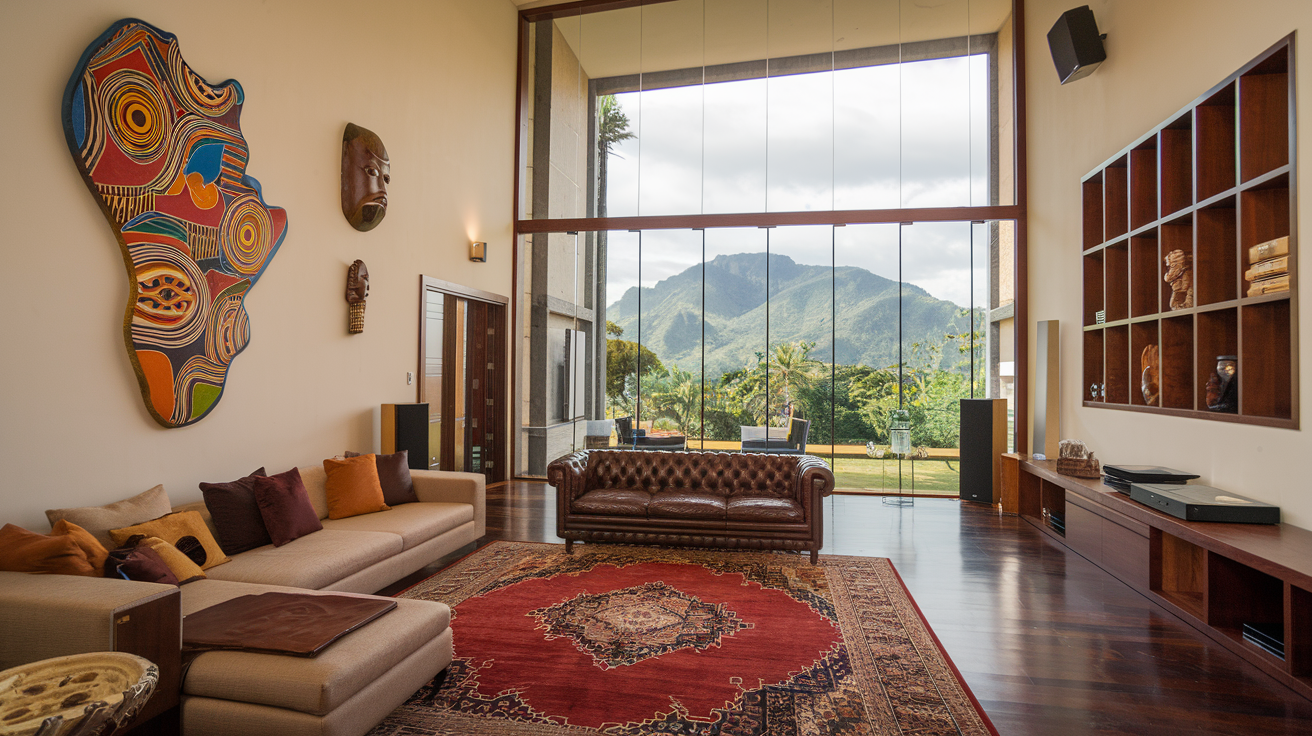
The commonest mistake in hanging art is buying too small. A canvas that looks generous propped against a shop wall looks apologetic once it is up, because the wall it is going on is bigger than the one you imagined, and because rooms flatten scale in a way showrooms do not.
The correction is arithmetic rather than taste. On an open wall, art should occupy roughly 60% of the available width. Above furniture, it should be about two thirds to three quarters of the width of the piece below it. Almost everything else about choosing large-scale work follows from those two numbers.
Work Out the Size Before You Look at Anything
Measure the wall, apply the ratio, and take that figure shopping. Choosing a work and then hoping it fits is how people end up with something that never quite settles into the room.
The Rules Worth Knowing
Hang lower than you think. The centre of the work should sit about 145 to 152 cm from the floor — museum convention, and considerably lower than most people instinctively place it. The commonest domestic error after buying too small is hanging too high.
Above furniture, leave a hand’s width. Fifteen to twenty centimetres between the top of a sofa or console and the bottom of the frame. Less and it looks stuck on; more and the two stop reading as a group.
Err larger. A work slightly too big reads as confident. One slightly too small reads as an accident. If you are between two sizes, take the larger.
Test it with paper first. Cut a sheet to the dimensions, tape it to the wall, and leave it for a day. It costs nothing and settles the question better than any amount of measuring.
One Large Work or Several Smaller Ones?
A single large piece is the strongest choice for a wall you want to be quiet. It gives the eye one place to rest, it suits rooms with a lot going on elsewhere, and it is easier to live with over years. It is also more expensive per square metre and harder to move.
A pair or triptych works where the wall is wider than any single piece you can find or afford. Keep the gap consistent — six to ten centimetres — and treat the group as one object when calculating the span.
A gallery wall suits collections rather than purchases. It absorbs mismatched sizes and frames, which a pair does not, and it grows with you. The discipline is spacing: uneven gaps read as a mistake, whereas mixed frame sizes do not. Lay the whole arrangement on the floor and photograph it before a single nail goes in.
Original Work, Print, or Reproduction
At large scale the price difference between these becomes substantial, and it is worth being clear about what each actually is.
An original is a unique work. It carries the artist’s hand, it has a resale market if the artist develops one, and it is the only category that appreciates. At two metres it is also a serious purchase.
A limited edition print is signed, numbered and finite. The scarcity is the value, so ask for the full edition number including artist’s proofs — an edition of 50 with 15 undisclosed proofs is an edition of 65. Editions are priced by scarcity rather than size.
An open edition or giclée reproduction is an inkjet print with no limit on how many exist. It is a perfectly reasonable thing to buy and it will not appreciate. The word to watch for is “reproduction” — if a seller avoids it while implying scarcity, that tells you something.
For a large statement wall, the honest trade is this: a two-metre reproduction costs a few hundred and will look exactly as good on day one as it does on day one thousand. A two-metre original by an emerging artist costs several thousand and is the only version of the three that is worth anything later.
The Costs After the Price
Large work is disproportionately expensive to move, frame and hang, and those costs are routinely left out of the budget.
Shipping is charged on volumetric weight, so a large light canvas costs more to send than a small heavy sculpture. Crating a two-metre work adds substantially. Estimate it before committing.
Framing is priced by the metre of moulding, so cost rises with perimeter. Glazing a large work is where the real money goes — and at that size, acrylic rather than glass, both for weight and because glass at two metres is a genuine hazard. Run the numbers on the size you are considering.
Hanging a large work is not a picture-hook job. Anything over about ten kilos needs fixings into studs or masonry, and a two-metre canvas needs two points rather than one to stay level. Budget for someone who does this professionally if you are unsure — the alternative is a repair to both wall and work.
Insurance matters at this scale because household policies frequently cap single items well below what a large original costs. Check the per-item limit before assuming you are covered.
Room by Room
The rules above hold everywhere, but each room applies them differently, and the differences are mostly about how people move and where they look.
Living room, above the sofa. The most common placement and the one most often got wrong. Measure the sofa, not the wall. A three-metre sofa wants roughly two metres of art, which is larger than most people buy. Hang it low — fifteen to twenty centimetres above the back — so the two read as one arrangement rather than two separate objects sharing a wall.
Living room, open wall. This is where a genuinely large single work earns its place. With nothing below it to anchor against, the piece has to hold the wall by itself, and anything under half the wall width will float. Keep the centre at eye level even though the instinct on a tall wall is to lift it.
Dining room. People are seated, so the sightline drops. Hanging five to ten centimetres lower than you would elsewhere makes the room feel considered rather than formal. Avoid glass if the table is directly opposite a window, because everyone will spend dinner looking at a reflection.
Bedroom, above the bed. Same rule as the sofa: measure the bed. A king-size headboard wants around 130 to 150 cm of art. Weight matters more here than anywhere else — use two fixings into studs, and consider whether you want two metres of framed glass above your head at all. Canvas or acrylic glazing is the sensible choice.
Hallways and stairwells. Narrow spaces have no viewing distance, so large gestural work will never be seen whole. These are the places for detailed work, prints and gallery walls, which reward being close. Stairwells are also where hanging heights get complicated: align to the middle of each work at eye level from the stair itself, not from the floor below.
Home offices. Behind the desk is now a video-call background, which is a genuine consideration rather than a joke. Large flat colour reads well on camera; fine detail and text do not, and anything highly reflective will show your monitor back to the meeting.
Materials at Scale
What a large work is made of matters more than at small sizes, because weight, transport and light exposure all scale badly.
Stretched canvas is the practical default. Light for its size, no glazing needed, and it can be transported off the stretcher and re-stretched on arrival, which cuts shipping costs substantially on international purchases. Ask whether the artist will ship it rolled.
Works on paper need glazing, which at two metres means acrylic rather than glass — lighter, safer and less prone to shattering, though it scratches and attracts dust. It also needs conservation-grade mounting, because acidic board will burn a visible line into the sheet within a decade.
Panel and board are heavy and rigid, which makes both shipping and hanging harder. Beautiful, and worth the trouble for the right piece, but check the fixings your wall can take before committing.
Textile and tapestry solve several problems at once: light, rollable, no glazing, and acoustically useful in rooms that echo. An underused category at large scale, and one where contemporary African practice is particularly strong.
Metal and mixed media can be very heavy indeed. Get the weight in writing before you buy, and establish what your wall construction is — plasterboard without studs will not hold a substantial metal work at any price.
Mistakes That Cost Money
Buying before measuring. The single most expensive error, because large work is difficult and costly to return. Measure, apply the ratio, then look.
Ignoring the route in. A two-metre stretched canvas has to get through your front door, round the stairs and into the room. Measure the narrowest point on the path, including door frames and any turn on a landing. This catches people regularly and there is no remedy once the work is standing in the hall.
Hanging in direct sunlight. Fading is gradual, irreversible and not covered by most insurance. Works on paper, watercolours and photographs are the most vulnerable. If the only wall available faces a south window, buy accordingly — oil on canvas will survive what a print will not.
Underestimating the framing. On a large work, framing can approach the cost of the piece itself, and it is not optional for anything on paper. Get the framing quote before you agree the purchase price, not afterwards.
Assuming a big canvas is a bargain. Price per square metre falls as size increases with reproductions and rises with originals, because a large original takes disproportionately longer to make. A two-metre painting is not twice the work of a one-metre painting; it is frequently four times.
Choosing What Goes On It
Beyond size, three considerations decide whether a large work settles into a room or fights it.
Take a colour from the work and use it elsewhere. A cushion, a book spine, a vase. It makes the painting look as though it belongs rather than as though it arrived. The reverse also works: if you are choosing a wall colour to hang art against, sample a quiet colour from the painting itself. Our colour tool builds a palette around a single hue.
Consider the viewing distance. Large gestural work needs room to step back — in a narrow hallway you will never see it whole. Detailed work rewards proximity and is wasted at the far end of a double reception room.
Think about the light the room actually has. North-facing daylight is cool and steady; west-facing evening light is warm and will shift every colour in the work. Direct sunlight will fade almost anything on paper within a few years, irreversibly.
Lighting Large Work
Most domestic art is badly lit, and at scale the problem compounds — a single ceiling spot on a two-metre canvas produces a bright patch and two dark corners.
Light from an angle of about thirty degrees. Steeper and you get glare on any glazed or varnished surface; shallower and the light rakes across the texture, exaggerating every irregularity in the canvas weave.
Use two or three sources across a wide work rather than one strong one. Even coverage matters more than intensity, and the eye notices a gradient long before it notices dimness.
Match the colour temperature to the room. Around 3000K reads warm and domestic; 4000K is closer to gallery daylight and will make cool colours sing but can leave a living room feeling clinical. Whatever you choose, keep every fitting on the wall the same — mixed temperatures on one work look like a fault.
Keep the levels modest on anything vulnerable. Museums light works on paper at very low levels for good reason. Cumulative light exposure is the main cause of fading, and it is a function of intensity multiplied by hours. A dimmer is a conservation tool.
LED rather than halogen. Less heat, no ultraviolet output, and a far longer life. Halogen picture lights look handsome and cook the top of the work over years.
Living With It Afterwards
Large work needs slightly more thought than small work once it is up, and almost none of it is difficult.
Dust the surface, do not clean it. A soft dry brush, occasionally, in one direction. No cloths, no water, and absolutely no household spray — varnish and acrylic glazing are both easily damaged, and the marks are permanent.
Check the fixings once a year. Buildings move, plaster settles, and a heavy work that has slipped five millimetres will slip further. Thirty seconds with a spirit level tells you.
Watch the wall behind it. Damp shows up on the reverse of a work long before it shows on the wall, particularly on exterior walls and behind furniture that blocks air movement. Take the piece down and look at the back once a year.
Photograph it now, not later. A dated photograph of the work in good condition is what you will need for any insurance claim, and it takes a minute. Keep it with the invoice and any condition report.
Keep the documentation together. Invoice, certificate, condition notes, the artist’s details and the photographs. For an original this becomes the provenance record that determines what it is worth to the next owner, and its absence is what depresses value at resale more than almost anything else. The chain starts with you.
Where Large Original Work Comes From
If you want something other than a mass-market canvas, four routes are worth knowing.
Directly from artists. Studio visits, degree shows and open studios are where large work is cheapest, because the artist is not paying a gallery margin and because big pieces are hard for them to store. Degree shows in particular are the best value in the market.
Through a gallery. More expensive, but you get advice, a condition report, provenance from the studio forward, and someone accountable if something goes wrong.
At an art fair. Concentrated choice and the ability to compare, though the environment is designed to compress decisions. Walk the whole fair before buying anything.
Commissioned. For a specific wall this is more achievable than most people assume, and frequently no more expensive than buying finished work of the same size. Expect to pay a deposit, allow two to four months, and agree the dimensions in writing before anything is stretched.
Frequently Asked Questions
What size art should I put on a large wall?
Roughly 60% of the wall width for a single piece on an open wall. Above a sofa or console, measure against the furniture instead and aim for two thirds to three quarters of its width.
How high should large wall art be hung?
With the centre of the work about 145 to 152 cm from the floor. Above furniture, leave fifteen to twenty centimetres between the top of the piece and the bottom of the frame.
Is one large piece better than several small ones?
For a wall you want to be calm, yes. Groups suit collections and grow over time, but they need consistent spacing to avoid looking accidental.
How much does large wall art cost?
An open-edition reproduction at two metres runs to a few hundred. A limited edition costs more and holds scarcity. An original at that scale by an emerging artist typically starts in the low thousands, and is the only one of the three with a resale market.
What extra costs should I expect?
Crating and freight charged on volumetric weight, framing priced by perimeter with acrylic rather than glass at large sizes, professional hanging for anything over about ten kilos, and an insurance check on your per-item limit.
Can I commission a large work for a specific wall?
Yes, and it is more achievable than most people assume. Allow two to four months, expect a deposit, and agree the exact dimensions in writing before the canvas is stretched.
Enter your wall dimensions and any furniture below it, and the calculator returns the size to look for, the height to hang it, and a scale drawing of how it will sit — including pairs, triptychs and gallery walls.
Further reading: exact hook placement, framing costs, lighting art properly, and how to buy art online without overpaying.


 No products in the basket.