

In 2022 the Venice Biennale awarded two Golden Lions to Black women. Simone Leigh took best participant in the main exhibition, having become the first Black woman ever to represent the United States. Sonia Boyce took best national participation for the British pavilion, having become the first Black woman to represent Britain. Both firsts happened in the same fortnight, in an exhibition that had been running since 1895.
That is the shape of this subject: a run of firsts arriving very late and then very fast. What follows is thirty artists, from a sculptor working in Rome in the 1860s to painters in their thirties now, with what each is known for and where the market has placed them.
A Timeline of Firsts
The Pioneers
Edmonia Lewis (1844–1907) — of African American and Ojibwe descent, she moved to Rome in 1865 and carved in marble at a scale no one expected of her. The Death of Cleopatra was exhibited in 1876, then lost for a century, turning up in a Chicago salvage yard before entering the Smithsonian.
Augusta Savage (1892–1962) — sculptor and, decisively, a teacher. Her Harlem studio trained Jacob Lawrence, Norman Lewis and Gwendolyn Knight. Much of her own work was made in plaster because she could not afford bronze, and has not survived.
Elizabeth Catlett (1915–2012) — sculptor and printmaker who spent most of her career in Mexico, making work about Black women that treats them as monumental subjects rather than as documentary ones.
Alma Thomas (1891–1978) — a schoolteacher for thirty-five years who began painting seriously in retirement, developed her mosaic-like abstractions in her seventies, and had a solo show at the Whitney at eighty-one. Her work now hangs in the White House.
Betye Saar (b. 1926) — still working in her late nineties. The Liberation of Aunt Jemima (1972) put a rifle in the hands of a racist figurine, and remains one of the most consequential works of American political art.
Faith Ringgold (1930–2024) — took quilting, dismissed as craft and coded as women’s work, and used it to carry history painting. Die (1967) is in MoMA. She was also a children’s author, which reached an audience galleries never do.
Barbara Chase-Riboud (b. 1939) — sculptor and novelist whose bronze-and-silk works combine materials that should not hold together, and do.
Howardena Pindell (b. 1943) — painter and, from 1967, the first African American woman curator at MoMA. Her punched-paper canvases took abstraction somewhere it had not been.
Senga Nengudi (b. 1943) — sculptures from nylon tights filled with sand, stretched and activated by performers. A practice that anticipated by decades much of what is now taken for granted.
Contemporary Masters
Lorna Simpson (b. 1960) — pairs photographs with text so that the caption complicates rather than explains the image. First African American woman to exhibit at Venice, in 1990.
Carrie Mae Weems (b. 1953) — the Kitchen Table Series (1990) is among the most cited photographic sequences of the past forty years. First Black woman with a Guggenheim retrospective, in 2014.
Kara Walker (b. 1969) — cut-paper silhouettes that use the most genteel medium in art history for the least genteel subject in American history. A MacArthur Fellow at twenty-seven.
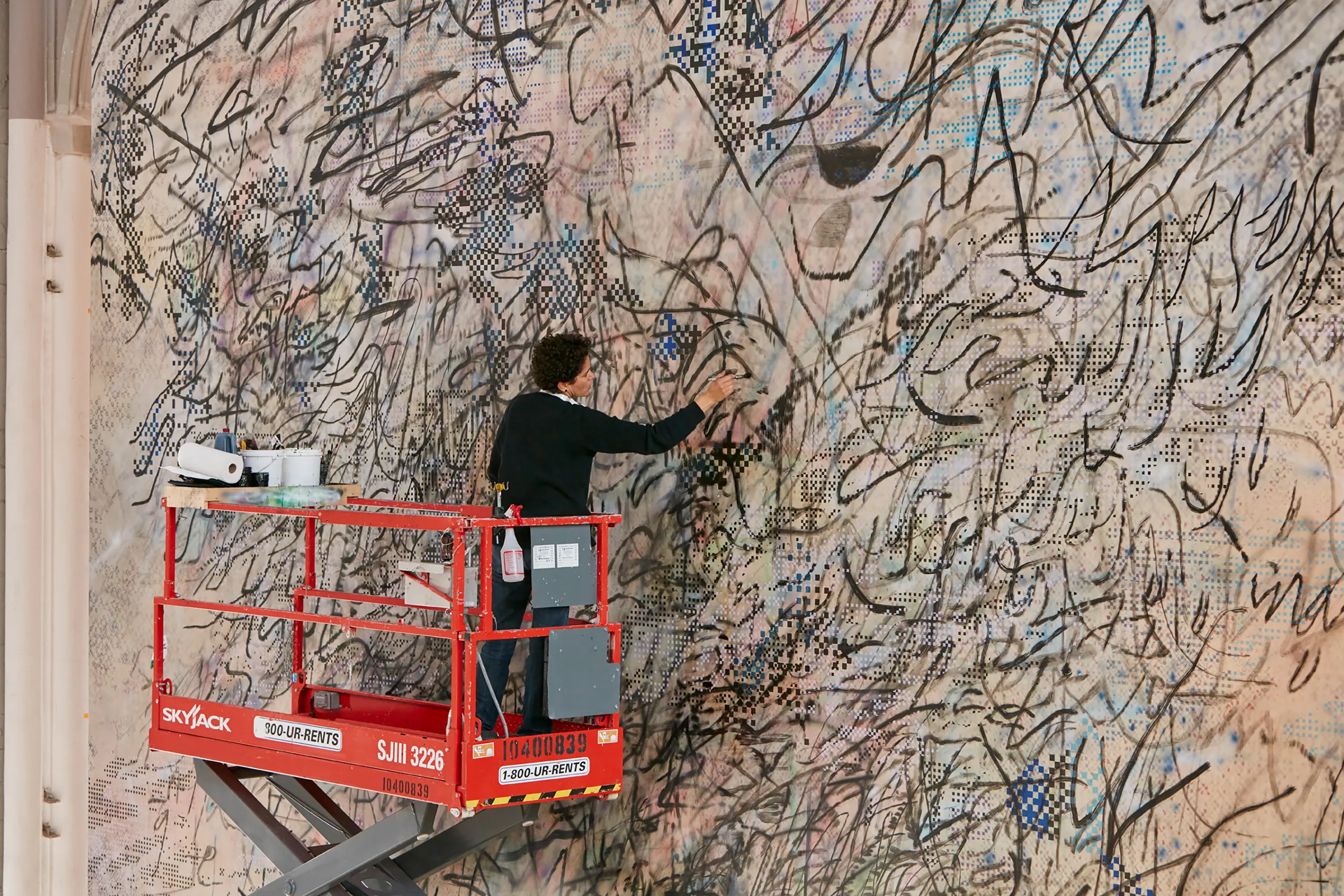
Julie Mehretu (b. 1970, Ethiopia) — layered architectural abstraction built from maps, plans and erased marks. Her $10.7 million result in November 2023 is the highest ever paid at auction for a work by an African-born artist of any gender.
Mickalene Thomas (b. 1971) — rhinestone-encrusted portraits that take the reclining odalisque of European painting and hand it back on entirely different terms.
Wangechi Mutu (b. 1972, Kenya) — hybrid figures fusing woman, animal and water spirit. Given unusual prominence at the 2026 Venice Biennale, with a five-metre bronze in the Arsenale harbour and an entire room in the Central Pavilion.
Zanele Muholi (b. 1972, South Africa) — describes their practice as visual activism rather than photography. Somnyama Ngonyama, an ongoing series of self-portraits made with everyday materials, is among the most widely exhibited photographic bodies of the past decade.
Amy Sherald (b. 1973) — paints skin in grisaille against flat saturated colour, which removes the viewer’s ability to read race in the usual way. Painted Michelle Obama’s official portrait in 2018, and holds one of the highest median auction prices of any woman artist working.
Simone Leigh (b. 1967) — ceramic and bronze figures drawing on West African architecture and Black women’s labour. Represented the United States at Venice in 2022 and took the Golden Lion.
Sonia Boyce (b. 1962) — British artist working in collaboration, improvisation and archive. Took the Golden Lion for the British pavilion in the same year.
Lynette Yiadom-Boakye (b. 1977) — paints fictional people from imagination rather than sitters, usually in a single day, in a tradition running through Manet and Sickert.
Njideka Akunyili Crosby (b. 1983, Nigeria) — layered interiors combining painting, drawing and photographic transfer, holding Lagos and Los Angeles in the same room. Auction record $4.7 million in 2022.
African Contemporary Practice
Otobong Nkanga (b. 1974, Nigeria) — drawing, installation, textile and performance on land, extraction and what is left behind. Her 2026 Venice commission clads the Central Pavilion columns in brick and living plants intended to obscure them by the exhibition’s close.
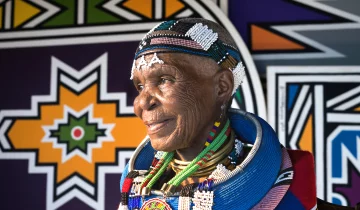
Esther Mahlangu (b. 1935) — brought Ndebele wall painting into the contemporary canon. In 1991 she became the first African and first woman to paint a BMW Art Car, and she is still working in her nineties, still without a stencil.
Ghada Amer (b. 1963, Egypt) — embroiders on canvas, deploying a medium coded as women’s work to carry imagery that is anything but domestic.
Billie Zangewa (b. 1973, Malawi) — hand-stitched raw silk collages of ordinary domestic life, made without a sewing machine, in which the offcuts and irregular edges are kept.
Peju Alatise (b. 1975, Nigeria) — sculptor, architect and novelist, and among the defining voices of contemporary Nigerian art.
Nike Davies-Okundaye (b. 1951, Nigeria) — adịre textile artist who has trained thousands of women through art centres she built herself.
Sokari Douglas Camp (b. 1958, Nigeria) — steel sculptor working in London for four decades, among the first African women collected internationally at scale.
The Generation Arriving Now
Toyin Ojih Odutola (b. 1985, Nigeria) — builds skin in dense layers of pen, charcoal and pastel until it reads as terrain, within an invented aristocratic family narrative.
Tschabalala Self (b. 1990) — constructs figures from sewn and painted fabric, building the body rather than depicting it.
Jordan Casteel (b. 1989) — large-scale portraits of people she meets, mostly in Harlem, painted from her own photographs and at a scale usually reserved for history painting.
Deana Lawson (b. 1979) — staged photographic portraits in domestic interiors. In 2020 she became the first photographer to win the Hugo Boss Prize.
Christina Quarles (b. 1985) — entangled bodies that refuse to resolve into separate figures. Auction record $4.5 million in 2022.
What the Market Says
Set against the wider picture, the numbers remain small. Of the 500 most expensive works sold at auction in 2022, fifty were by women of any background. Of the top hundred, two. Of the top fifty, none.
Within that, Mehretu’s $10.7 million is the outlier that proves the direction rather than the arrival — it is roughly a fiftieth of what a Leonardo makes, and it stands as a record for an entire continent.
What has changed materially is the speed at which artists are now collected. Crosby, Quarles, Casteel and Self were being acquired by institutions within a few years of leaving graduate school. Alma Thomas waited until she was eighty-one. That compression is the real story of the past decade.
Frequently Asked Questions
Who are the most famous Black women artists working today?
Kara Walker, Julie Mehretu, Amy Sherald, Simone Leigh, Lynette Yiadom-Boakye, Zanele Muholi, Wangechi Mutu and Njideka Akunyili Crosby are the names most consistently held by major institutions and the strongest at auction.
Which Black woman artist sells for the most?
Julie Mehretu, whose Walkers With the Dawn and Morning made $10.7 million at Sotheby’s in November 2023 — also the highest auction price for any African-born artist.
Who was the first Black woman to represent the United States at the Venice Biennale?
Simone Leigh, in 2022. She won the Golden Lion for best participant in the main exhibition. Sonia Boyce represented Britain in the same year and won the Golden Lion for best national participation.
Who was the first African American woman with a solo show at a major American museum?
Alma Thomas, at the Whitney in 1972, aged eighty-one.
Which African women artists should collectors know?
Julie Mehretu, Wangechi Mutu, Otobong Nkanga, Njideka Akunyili Crosby, Zanele Muholi, Esther Mahlangu, Ghada Amer, Billie Zangewa, Peju Alatise and Toyin Ojih Odutola.
Where can I see work by Black women artists?
The Studio Museum in Harlem, the Smithsonian’s National Museum of African American History and Culture, Tate Modern, Zeitz MOCAA in Cape Town, and the Brooklyn Museum hold the deepest collections. Most major museums have acquired significantly since 2015.
Buying from a living artist or their gallery gives you the cleanest provenance available — the chain starts in the studio and you are the first owner after it. MoMAA represents contemporary African and diaspora artists, with works available directly.
Auction figures verified against published results, September 2026. Further reading: 50 most influential women artists, Wangechi Mutu at Venice 2026, Otobong Nkanga’s Venice commission, and African art provenance.


 No products in the basket.